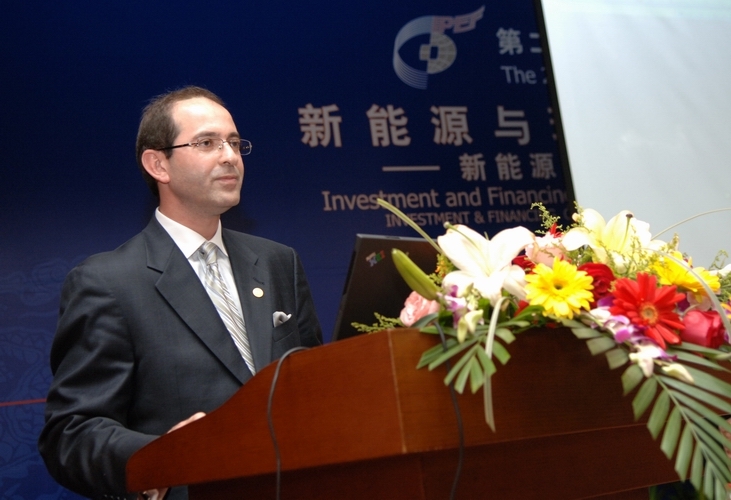
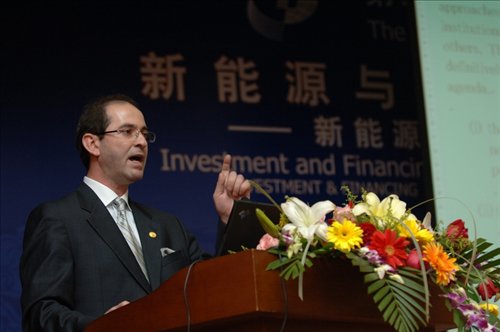
Eurorient | Mr. Ron Nechemia Opening Remarks for China 2nd International Private Equity Forum "Managing Climate Risk and Capturing the Opportunities: Towards An Investment Framework"
As Prepared for Delivery
Speech by Mr. Ron Nechemia
The Chairman of the Board of Directors of
EurOrient Financial Group
China 2nd International Private Equity Forum
Investment in New Energy and Environment Technology Forum
Tien Jin City, the People’s Republic of China
June 11, 2008
Your Excellency the Mayor Mr. Huang Xingguo, esteemed
Ministers, Provincial and Local Government Leaders,
Distinguished guests, Ladies and Gentlemen, It is a pleasure to welcome you to the Investment in New Energy and Environment Technology Forum.
I would like to pay tribute to the City and State of Tien Jin, and to the people and Government of Tien Jin for generously hosting this event.
I would also like to congratulate High-Tech Group for organizing this important event.
It has been a great honour for me to be given the opportunity to speak in front of you at the opening ceremony of this very important event and it is my privilege to convey a message to this important gathering. “Safeguarding the environment ... is a guiding principle of all our work in support of sustainable development; it is an essential component of poverty eradication and one of the foundations for peace”. I am truly delighted to witness this great gathering of leaders joined by a devotion to our planet and a commitment to peace.
This conference comes at an opportune moment. The world has what it takes to improve living standards for all people. We have years of experience that have taught us what works, and what does not. We have new technologies that protect the environment and spread a wealth of information. We have an unprecedented political consensus around the Millennium Development Goals. What we lack, all too often, is coherence and adequate financial resources, which is rightly the main theme of this conference.
A Renewed Call for Action
The Rio Summit, which was held in Rio de Janerio, Brazil in 1992 was the great beginning of the global push for action on behalf of the environment. But it was only a beginning. Your presence today, at this special event testifies to the fact that the cause of the environment is alive, that it is thriving, and that it is gaining support with every passing day.
The threat to our environment has taught us that a decaying habitat for one people is a decaying habitat for all. It has also taught us that privilege and prosperity cannot protect any nation, if poverty and pollution are destroying another. We have learned that sustainable development is a calling not for only one people or region, but a calling for all.
When we talk about the environment, we are not speaking only of ecosystems and resources but about most of the key issues on the international agenda. We are talking about the way we live -- sustainably or unsustainably; about poverty and inequality; and about peace and security, since the roots of conflict can also be found in competition over land, oil and water. We are talking about democracy, and the involvement of men and women in the decisions affecting their lives. And we are talking, not least, about shared values and goals: working jointly to see that the benefits of economic growth and development are shared not only among countries, but among generations as well. Safeguarding the environment is, in short, a quintessential global challenge.
Considering the environmental consequences of our actions must become second nature to us all, in every choice and every decision we make; if it does not, all the laws and regulations, government programmes and market incentives in the world will not be enough to save us from environmental disaster.
Recognizing that climate change embodies risks and opportunities of a significant magnitude for investors and to global economy, and represents one of the greatest challenges facing our planet, we shall be compelled to seek improved approaches in responding to the fiscal ramifications of climate risk for institutional investors, fund managers and financial advisors, companies, and others. Therefore, I call on each of these sectors to respond, affirmatively and definitively, and state the intention to move forward to implement this essential agenda.
(i) the need for, and investment requirements of, meeting modern energy needs for developing countries over the long term in a manner that provides attention to efficiency and local environmental considerations;
(ii) the additional steps needed in the energy, transport, and industrial sectors to address climate change mitigation through the reduction of greenhouse gases; and
(iii) the impact of climate change and the need for developing countries to adequately adapt to changes in climate and weather variability. These three issues are critical to the China’s core mission of poverty reduction and to the rest of developing world, as well as for the realization of many of the Millennium Development Goals, and other agreed upon international development goals and objectives.
Working toward the potential of “double dividends”. By meeting the energy needs that are essential for economic growth and fighting poverty, while at the same time leaving a smaller environmental footprint. Recognizes that meeting developing countries’ energy needs is both an urgent and difficult challenge, which requires domestic policies that provide incentives for efficiency in energy production, delivery, and use and incentives for public and private resource mobilization.
We must recognize that climate change can undermine development and that dealing with climate change will require the development and implementation of climate-friendly technologies as well as adapting to climate change.
Today’s challenge: reliable, clean, and efficient energy. Developing countries must accelerate access to affordable and reliable modern energy services to decrease poverty and increase productivity, enhances competitiveness, and thus improves their economic growth prospects. Without access to modern, clean, and sustainable energy services, the poor are exposed to unhealthy air pollution and deprived of modern energy services, which provide lighting, cooking, heating, refrigeration, transportation, motive power, and electronic communication that are indispensable to increasing productivity, creating enterprises, employment, and incomes. Maintaining current policies and technology choices will have highly undesirable economic, social, and environmental outcomes.
Energy sector policy reform is urgently required to stimulate the investments needed for developing and transition economies to meet their energy needs. Much of the investmentneed is unmet because of policy constraints: addressing these problems through joint public and private participation and working across the spectrum of public and private interventions are required. Actions needed include establishment of credible legal and regulatory frameworks; development of enabling policy environments through regulatory interventions such as appliance energy efficiency standards, mandated utility demand side management programs, and mandatory energy audits; creation of market-based approaches such as emissions trading, energy service companies, energy performance contracts, and credit guarantees; and information dissemination regarding energy savings and clean energy options.
Strengthening energy security is essential to alleviate some of the macroeconomic concerns of developing countries by diversifying supply and rationalizing energy use. Improvements in the effectiveness of energy use should be assigned a high priority because of its three-fold impact of improving energy security, reducing costs and decreasing environmental impacts.
An extensive array of clean and efficient energy supply and demand technologies exists.On the supply side, technologies aim to enhance access to clean and efficient energy,improve energy security, and promote environmental protection at the local, regional and global level. They include new thermal power plants based on combined cycle and supercritical boilers; natural gas as a bridging fuel in the transition period until renewable energy technologies become commercially viable; new renewable energy technologies (solar, wind, small and large hydro, biomass/biofuels and geothermal sources); and nuclear fission.
Energy supply technologies are complemented by end-use efficiency technologies in thetransportation sector (including efficient gasoline/diesel engines); the buildings sector(insulation, advanced windows, new lighting technology, efficient space cooling and heating); the industrial sector (cogeneration, waste heat recovery, pre-heating, new efficient process technologies, efficient motors/drives, improved control systems); the agricultural sector (efficient irrigation pumps); and in municipalities and urban centers (district heating systems and combined heat and power).
Low-cost, high impact approaches to providing clean energy should be addressed first. The first element is where investments and expenditures can be made in a “no regrets” format,that is, where clean energy investments are financially attractive under sound, commerciallyviable policies. An example is improving the efficiency in the production and use of energy.The second element would address promising new technologies that are not currently financially viable, but could be supported through taxes and subsidies that internalize the environmental costs of local and regional pollution. The third element would include a research and development program for promising new technologies that could yield commercially viable results within 10 to 25 years.
The International Energy Agency estimates that a total capital investment of $8.1 trillion, equivalent to an average of $300 billion per year (in 2005 dollars), is needed from 2003 to 2030 for the developing and transition economies to meet their energy needs, of which electricity comprises roughly 73 percent, oil 12 percent, natural gas 12 percent and coal 3 percent.
Financing for the energy supply sector comes from three sources: internal cash generation, private financing, and public funding. One challenge in the energy sector is the electricity sub-sector where the current levels of investments are about 50 percent of the needs, that is, about $80 billion per year out of $160 billion per year. The extent to which the huge investment gap, especially in the electricity sector, can be funded in the future would depend on the pace of policy and regulatory reform, including the measures needed to attract private sector investment in developing countries and transition economies. End-use efficiency improvements in the transportation, industry, commercial and residential sectors can also have a significant impact on the clean energy investment requirements. Consultations with the private sector have confirmed that private investments in cleaner energy in developing countries will not occur without better risk management cover, especially in regulated industries.
Your Excellencies,
Distinguished guests, Ladies and Gentlemen,
Elephants, whether asleep or awake, evoke many things to many people. A former Governor of Brazil's Central Bank said his country's domestic debt was like having an elephant sleeping in the basement of your house, and wondering when it would wake up and ask for peanuts.
As we see this magnificent animal stand before us today, it was worth the wait. The sheer size of this creature humbles us. And so it should. For it shows us that some things are bigger than we are. It tells us that the Earth is not ours, but a treasure we hold in trust for future generations. It teaches us that if our global village is to be a truly desirable place for all of us on this planet, it must be guided by a wish to nurture and preserve, and not to threaten or destroy, the variety of life that gives it value. And so, as the animal that never forgets, let the elephant serve as our institutional memory; let us remember that when future generations come to this garden as mature adults, this elephant will still be here. As we walk by it in the days and years to come, may all five tonnes of it stand as a daily reminder that we are all in debt to Mother Earth; that we ignore this at our peril; and that if and when the elephant wakes up because we have failed in our duty, chances are it will ask for much more than peanuts.
The "MANAGING CLIMATE RISK AND CAPTURING THE OPPORTUNITIES" is an extraordinary challenge -- a challenge to States, international organizations and civil society as well as to the private sector to address, in an integrated way, an array of related global problems. And to institute, in response, basic changes in our individual and collective behaviours. Equally inspiring, it forged an alliance of State and non-State actors committed to the pursuit of sustainable development.
I would conclude my speech by sharing with you a quotable from the former Secretary General of the United Nations, Mr. Kofi Annan, which he once told during Toast at Luncheon for Heads of State and Government Attending Special Assembly Session on Environment and Development "The Earth is not ours", an African proverb teaches. "It's a treasure we hold in trust for future generations."
By convening here today, you have shown that you are worthy of that trust. Emboldened and inspired, I urge you to return home recommitted to our earth, and determined to honour the faith of future generations.
In that spirit, I offer you my best wishes for a successful outcome to this important event, and I look forward to reviewing the recommendations that will emerge from these most serious and vital consultations.
Thank you very much.
Ron Nechemia