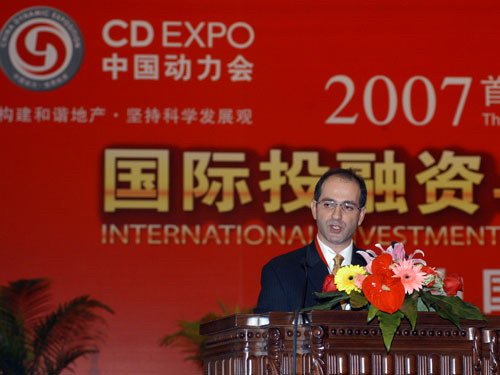
 | EurOrient | Mr. Ron Nechemia Opening Remarks at the CEDXPO Forum Held at Great Hall of People, Beijing (人民大会堂), China “Sustainable Development for All: Socially Responsible Investment for Rural and Urban Development” |
Speech by Mr. Ron Nechemia
The Chairman of the Board of Directors of
EurOrient Financial Group
The Great Hall of People (人民大会堂)
Beijing, the People’s Republic of China -
December 4, 2007
As Prepared for Delivery
Mr. Chairman,
Central, Provincial and Local Government,
Distinguished experts and observers,
Ladies and Gentlemen,
It is a great honor being here today,
In my speech I will try my very best to take a comprehensive view of key action areas that we need to be address in a coordinated and integrated manner to achieve sustainable development for all. In my article included herein, I deal with how to enhance the quality of life for people and in particularly the quality of life of the poorest, how to enable all members of society to become productive economic agents, and how to include them in a more democratic society. The introductory article presents an overview of the current situation of poverty and inequality in Asia and in particularly in the People’s Republic of China (“China”), and discusses ways in which the market can help reduce them.China has grown rapidly since 1978, when it began to reform. Over the past 30 years, it has shifted from a centrally-planned to a market economy, and maintained gross domestic product (“GDP”) growth of about 9 percent per year, and lifted 400 million people out of poverty. Considerable progress has also been made in implementing the structural reform agenda and achieving the commitments made during China’s accession to the World Trade Organization (WTO) in 2001. With a population of 1.3 billion, China recently became the world’s fourth largest economy and third largest trading nation.
Even so, China remains a developing country, with gross domestic product per capita about $1,740 and more than 135 million people living on less than $1 a day—mostly in rural areas in the lagging inland provinces. It also faces daunting challenges in maintaining rapid growth; managing the resource demands and environmental consequences of growth; and addressing the resulting inequalities in income and opportunity, which could otherwise undermine the consensus needed to undertake growth-oriented policy reforms.
Housing is one of the fundamental demands for living. Access to acceptable housing is also one of the elementary human rights as well as one of the keys to peace and happiness. In every country, resolving housing issues has political, social and economic significance. To solve housing issues, every country has formulated its own specific housing development program and developed its unique program operating mechanisms. Many countries have especially drawn up the development program of public housing to assist low and middle-income groups solve their particular housing-related issues. It is believed that housing of low and middle-income groups is the major housing issue and the primary subject of housing policy in urban China too.
Poverty Eradication: A Policy Perspective
Part of the slow progress in reducing poverty all around the world is explained by the high level of inequality that prevails. As a result, poverty rates are disproportionately high given average income levels in the region. Countries such as China with high income inequality requires higher gross domestic product (“GDP”) growth rates to reduce poverty than those with relatively lower inequality. Recent studies of the distribution of the benefits of growth across income groups (pro-poor growth) highlight that the low impact of GDP growth on poverty reduction. This is a serious policy concern for China as well as to other developing countries.
Efforts are also needed to improve housing conditions for the poor. Even though, the proportion of the urban population living in shanty-towns decreased between 1990 and the early 20000, the number of persons living in shanty-towns increased with urban population growth. There is increased evidence that poor housing conditions relate and contribute to social disadvantage and vulnerability.
Housing situations are not simply products of poverty but also contribute to the difficulties facing households and affect the social integration of those who dwell in them. Poor social integration in marginalized neighborhoods affects human capital accumulation, increases vulnerability to crime and violence and reduces labor market participation. Urban segregation is also related to poor quality schooling and social problems. Lack of adequate housing is closely related to lack of water and sanitation services and leads to precarious living conditions that contribute to increased vulnerability to natural disasters. Public-private partnerships are key to ensuring adequate housing for the poorest.
Urban Infrastructure and Services
As the quality of housing is closely linked to its neighborhood, housing policies must concentrate on the adequate provision of basic urban services and infrastructure. Although these components usually fall outside the housing sector, they provide essential services to households. Municipalities play a key role in the provision of well-located, basic urban services, such as health, education, and recreational facilities, and trunk infrastructure, such as of roads, potable water, and sewerage, all essential to the wellbeing of the population. Housing programs must support the development of proper institutional and financial mechanisms that ensure the sustainable provision of these services.
Public Transportation Focused on the Accessibility of Poor Areas
Investing in public transportation makes better use of resources, reduces pollution and better serves the low-income population, which tend to be its most frequent users. Yet, public transportation is usually poorly maintained, unsafe, highly polluting and often uncomfortable; in addition, coverage is often limited. Key objectives in this regard are to support the planning and financing of urban transportation systems and infrastructure, seeking to expand service coverage and effectiveness and to increase access for low-income people.
Improving mass transit and trunk infrastructure that affects urban growth patterns are endeavors that are not limited to the transportation sector. They need to be coordinated with urban planning strategies that regulate density, facilitate access to land by the poor, and organize the location of different activities in the cities. In addition, accessibility for the poor in densely populated urban areas is a major social policy issue. Providing better means of public transportation for residents of poor neighborhoods is a form of “transportation equity” (a concept explored by Margareth Pugh in Barriers to Work: The Spatial Divide Between Jobs and Welfare Recipients in Metropolitan Areas), which should be an integral part of welfare programs if they are to be successful.
Institutional Developments for More Efficient Housing Policies
The efficient use of public funds to support the housing sector is essential. The public sector must help markets achieve greater efficiency, while the private sector takes on the responsibility of producing and financing houses. Public funds should only be used for subsidies as a last resort, after other means of facilitating housing access to low-income households have been explored and proven unfeasible or insufficient.
Effective urban development and environmental planning, such as the enforcement of land use and subdivision regulations, helps prevent or mitigate environmental risks in urban settlements. However, these regulations are often ineffective because they are systematically bypassed when governments are incapable of ensuring compliance and the low-income population cannot afford them. Alternatively, it is important to develop low-cost approaches that focus on reasonable and enforceable rules and identify and reduce vulnerability to environmental hazards, while at the same time avoiding the worst ills of informal settlements (lack of critical basic services, overcrowding, poor accessibility and lack of light and ventilation in the dwellings). Supporting effective risk management involves disseminating simple disaster-resistant building codes and encouraging housing agencies to work with those organizations responsible for hazard mapping and municipalities in improving land use planning.
The Concept of Socially Responsible Investment
The concept of socially responsible investment (“SRI”) globally has undergone dramatic change since it emerged in the late 1980s, when the first SRI mutual funds emphasized strict negative screens. The emphasis on negative screens reflected the thinking at the time, rooted in values-based choices about environmental sustainability, human rights, international development, worker rights and corporate responsibility. Since that time, the concept has changed to include positive screening, shareholder activism, community investments, analysis and integration of environmental and social issues, sustainable investment capital and ethical lending. This reflects not just a change in society’s attitudes toward corporate responsibility, but a deeper understanding of the relationship between environmental and social issues and investment risk and return, a relationship excluded from traditional financial analysis.
In the last decade, the pace of change has been remarkably rapid. Spurred by massive public interest in issues such as climate change, HIV/AIDS and international development, many public pension funds and other financial institutions have signed the United Nations Principles for Responsible Investment, an international protocol for institutional managers pledging to adopt responsible investment policies and practices. This has increased awareness of new socially responsible investment tools, such as environmental, social and governance (ESG) analysis and integration, collaborative engagement among investors on social and environmental issues, and ESG proxy voting and corporate engagement.
This has prompted a reconsideration of the concept of socially responsible investment by the social investment associations around the world that represent the SRI industries in their respective jurisdictions. In September, 2006, EuroSIF (European Social Investment Forum) released the European SRI Study 2006, which developed a new conceptual approach to socially responsible investment in Europe. The approach broke new ground by describing SRI in terms of two general categories
· Core SRI; and
· Broad SRI.
According to the European Social Investment Forum framework, Core SRI includes strategies incorporating ethical exclusions as well positive screens, including best-in-class and pioneer screening. Broad SRI, in the European framework, includes simple exclusions, including norms-based screening; corporate engagement on social and environmental issues, and environmental, social and governance integration
I suggest the developing the methodology for Chinese Social Investment Forum, whereby researchers and advisors to the Review project studied of the European Social Investment Forum framework, and analyzed whether it would make sense to apply it to the Chinese environment. My recommendation is that the general conceptual framework of Coreand Broad Socially Responsible Investment is a useful analytical tool for the Chinese market; but that some modifications were necessary to apply this framework to the Chinese Socially Responsible Investment market. Therefore, the Chinese framework shall incorporates both Core SRI strategies, which are rooted in values based decisions about investment selection and management, as well as risk and return considerations; and Broad SRI strategies, which are primarily rooted in a fiduciary analysis of environmental, social and governance factors based on risk and return criteria.
Socially Responsible Investment in Real-Property
To what extent are these ideas impacting upon or being embraced within the world of real- property and urban development? My observation is that the effort in terms of the development of socially responsible investment protocol for real-property development and urban development applications, all around the world has been focused primarily on environmental considerations, and in particularly, creating environmentally sustainable new buildings, through the development process and controlling energy usage in, and emissions from, existing buildings. Less emphasis has been given to the social and community development, but the concerns which I have expressed in this Forum does exist. Our ‘welfare-to-work’ scheme - utilizing our shopping center as a route back into the workplaces for youth and for the long-term unemployed – in a way of such example.
Energy efficiency may be seen as one of the most essential elements of deliberate operational proficiency. It plays an important role in broader strategies and in deeper objectives that command for optimal management of property. As yesterday’s best practice evolves into today’s common place, sustainable and socially responsible behavior in the property environment is increasingly becoming, inevitable.
However, what I tried to concentrate on today – is to explore what socially responsible investment might mean for real-property investors and by identifying some areas of research, which with the assembly of brain power brought together in this room today could become very valuably driving force.
My concern is that, with a few honorable exceptions, there is precious little thought being given to the issue of socially responsible real-property investment. I will urge the audience, in the time that I have remaining, that unless real-properly and ground socially responsible investment protocols will be develop for real-property and for urban development applications in a clear appreciation of the particularities of property as an investment class, investment houses might well ‘thrash around’ doing worthy deeds but potentially missing on the greater opportunity for real-property investors to contribute to one of the increasingly more important issues of our day!. In order to better illustrate my thoughts and in a way of example – it is clear to me that all the work being done on sustainable developments and construction is of significant important to society as a whole. However, if a business case could be constructed for doing something on the far, far and of the more extensive existing stock of real-property and urban development, the cause of environmental sustainability and social development could take a bigger stride forward.
I am interested in provoking a discussion regarding investment appraiser, responsible contractor program, property management, child labor concerns, safeguard standards, and opportunities to extend influence in these areas via international and local funds.
I am increasingly concerned over environmental, social and moral issues and urging policy makers to hold corporate accountable for operating their business in socially responsible manners and become a good corporate citizen with respect to the communities they affect and operate within - both for the benefit of current and future generations.
Mr. Chairman,
Ladies and Gentlemen,
There are many recipes for achieving development for all. One factor that is often contentious, and more so in Asia than in other part of the world, is the degree of reliance on well functioning private markets: the legacy of the Washington Consensus is that there is no consensus at all. The liberal school of thought still proposes faith in the machinery of private markets, considering that somehow benefits from commerce and trade, and increases in economic activity will spread throughout society, trickling down to the less well-off. The past few decades have shown that, indeed, improvements in the functioning of private markets have increased economic activity, but the benefits have been very slow in reaching the poor, and reducing inequality has been elusive. In fact, inequality has increased, becoming one of the distinguishing factors of the region compared to other continents.
Humanly, ethically and politically exclusion, conscious or unconscious, is unacceptable. From a moral point of view, it is not possible to live placidly alongside the suffering that lack of basic necessities causes. Politically, failure to meet the needs of large parts of the population threatens basic democratic principles, and is in itself undemocratic. While the poverty reduction agenda of the international organizations may seem a lofty goal, this is really a primary responsibility for all members of society. While it may seem that for some economic actors, such as the private sector and civil society, other goals like profit maximization or general service to the public are principal to their functioning, their purpose can and should be aligned with the overarching goal of ending poverty. Even the private sector is waking up to the fact that the poor make good consumers, strong citizens and worthwhile stakeholders.
There are limitations to the well functioning of private markets and to the capture of benefits by the poor. While markets are a necessary condition, they are not a sufficient one. This is particularly true in developing countries, where institutional capacity is a real limitation and large portions of the population are not even included in “the market.”
I wish you every success in your deliberations on what are indeed watershed issues
Thank you very much.
Ron Nechemia
