 |
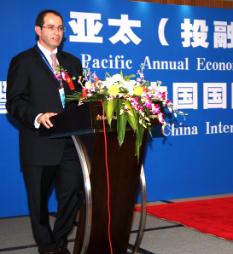
EurOrient | Mr. Ron Nechemia Opening Remarks for the Asia Pacific Economic Summit and China International Recycle Economy Summit "Bridging the Great Divide: Strengthening the Business Sector and Entrepreneurship” |
Speech by Mr. Ron Nechemia
Asia Pacific Economic Council
Beijing, the People’s Republic of China
January 18, 2008
As Prepared for Delivery
Honorary Chairman and Nobel Laurent Albert Arnold (Al) Gore Jr.,
Vice President to President William J. Clinton (1993-2001)
Ministers, Provincial and Local Government Leaders,
Distinguished experts and observers,
Ladies and Gentlemen,
It is a great honor being here today and having the honor to address this very special event of the Annual Meeting of the Asia Pacific Economic Council.
It is extraordinary how quickly the world is changing. Driven by new technology and new ideas, the world is fundamentally different as we entered into the new millennium than it was even only 20 years ago. The global shift from plan economy to market, the rising of the Asian economy, the continued integration of Europe and adoption of a single currency, the broadening and deepening of freer trade and investment, the integration of the less developed countries into global capital market and the ascendancy of global capital markets are transforming how commerce is being conducted.
The rise of multinational companies from emerging economies is a new phenomenon that changing the old school of thoughts: global companies from emerging economies buying business in richer countries as well as in poorer places. The economic theory says that this should not happen. Richer countries should export capital to poorer ones, not the other way around. Now a day we see companies like Tata Motors from India buying two grand old names of British carmaking, Jaguar and Land Rover, from the America’s enfeebled Ford, as a symbol of a shift of economic power. Understanding these trends and their implications is of a prime priority for academics, policy-makers and business professionals alike.
Questions such as do these developments vindicate the view that globalization opens up unprecedented opportunities for the South to catch up with the North? Are these "emerging multinational corporations" any different from their competitors from industrial countries? Does private sector direct engagement herald a new era for South-South cooperation? I suggest that, emerging multinational corporations must be analyzed in the context of the global political economy.
Change brings both challenge and opportunity. This is apparent in the financial services sector, where technology and new and innovative approaches to the management of risk are transforming the ways in which institutions compete with one another to serve customers who are becoming increasingly sophisticated.
One of the key leadership challenges of our time is to find new ways to harness the innovation, technology, networks and problem-solving skills of the private sector, in partnership with others and to do so in a manner that makes sound business sense, in a manner which does not replace or undermine the role of government. Without such investment, hopes for conquering poverty – and therefore for creating peaceful, stable, functioning societies on all continents -- will remain unfulfilled and will leave the world at greater risk of violence and other ills
Today’s small and medium size enterprises (“SMEs”) are the tomorrows "emerging multinational corporations". Access to financing represents an important issue for large and for small and medium size enterprises from developing economies. Financing gaps may arise due to agency problems, asymmetric information and other market and policy imperfections that can give rise to incomplete financial markets and constrain SMEs access to financing. Analysis reveals not one, but several kinds of financing gaps. Many developed countries have partial gaps, which tend to be severe especially in the early-stage firms. However, financial gaps are more pervasive in emerging, transition and developing economies.
Access to appropriate types of financing structures and facilities are especially required to allow SMEs and entrepreneurs to take advantage of the opportunities provided by innovation, notably through the diffusion of information and communications technology (ICT). They are also needed for SMEs with new business models and high growth prospects, as they make a very important contribution to economic growth accompanied by job creation and social cohesion;
Close examination into public policies affecting financial sector. With regard to SME financing globally indicates that there is insufficient data available and recommended a concerted effort to improve the quality and quantity of information on SME financing;
I suggest that the Trade and Industry Ministry, the appropriate government agencies which are in charge of statistical data gathering and the Ministry of Finance to work together in an ongoing effort to gather data on SME financing. To this end, the government shall established Center of Excellences dedicated to SME Financing and Entrepreneurship that promoting a unique, multidisciplinary approach to the study of entrepreneurial venture, which will be the hosting current and comprehensive data collection regime on SME financing and Entrepreneurship in the developing world. Through the Initiative, research and analysis will reveal a comprehensive picture of SME financing, covering the entire spectrum of financing products and services to be provided.
I urge the SME financing incentive shall be fact-based and supported by solid evidence in support of policy decision making and of policy reform.
We should be carefully examining the very important issues about the state of competition in financial services markets, the efficiency and competitiveness of our financial institutions, and how well SMEs are being served by them.
A key question is whether further changes in ownership policy, organization and powers are now appropriate. Will allowing greater flexibility in ownership policy reduce barriers to the entry of new institutions without unduly compromising safety and soundness? Can more flexible organizational forms provide a basis for nuanced regulation rather than a “one size-fits-all approach,” and can this help level the playing field between regulated and unregulated institutions and thus increase competition in the marketplace? Would the elimination of remaining restrictions on business powers benefit consumers? These are the issues that are addressed in this background paper; and
The primary objective shall be inquire into and make recommendations on the future policy and regulatory framework to govern the conduct and structure of financial institutions.
Mr. Chairman, Ladies and Gentleman,
The world may have changed, Excellencies, but those aims are as valid and urgent as ever. We must keep them firmly in our sights. It can take 30-50 years to fully transform a locality or region from “industrial economy” mode to “knowledge economy” mode. Successful local development in the knowledge-driven global economy requires places to be truly distinctive, appealing and productive. Just as firms must innovate and invest to succeed, localities have to adjust, reinvent, and differentiate themselves. They must modernize their transport, communications and other infrastructure and build up human capital. But all this comes at a cost.
Armed with the right tools and approaches, local development can emerge as an important arena for new investment that yields rates of returns that neither public nor private sectors can afford to ignore.
I wish you every success in your deliberations on what are indeed watershed issues.
Thank you very much.
Ron Nechemia
EurOrient Financial Group is a private sector global development finance institution. Its mission is to mobilize financial, technical and human resources for the benefit of developing economies seeking sustainable economic development and poverty reduction. EurOrient invests in projects and programs that promote social development, build human capacities, and address host government priorities for investments in physical infrastructure that promotes and enhances social development. These projects include roads, transportation and communication systems, water, sanitation and other types of investments with social development outcomes such as improved quality of life and increased human knowledge and skills.
EurOrient at Glance
Headquarters: Los Angeles, California
Website: www.eurorient.org
CEO: Mr. Ron Nechemia
Contacts
EurOrient Financial Group
Email: mail to: media.center@eurorient.org
