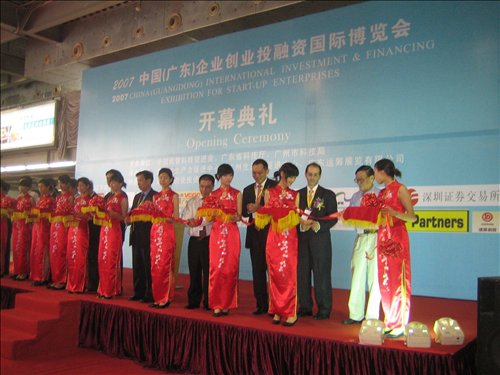
EurOrient | Mr. Ron Nechemia Opening Remarks to China International Investment Forum for a Start-up Enterprises “The Financing Innovative Small and Medium Enterprises in a Global Economy”
Guangdong, China – May 25, 2007 - Ladies and gentlemen, it is needless to say that I am very honoured to have been asked to comment on the very timely issue of financing innovative enterprises that are small and medium size enterprises (“SMEs”) in a global economy. I am particularly glad to have the opportunity to make this presentation on the China International Investment Forum for a Start-up Enterprises. This Conference features an extremely impressive list of speakers and panelists that the organizers of the Conference have assembled over the past months, and I greatly appreciate having the opportunity to be here on the first day to make contribution to what I am certain that is going to be a very productive exchange of ideas between the speakers and the participants in the Conference.
We gathered here together today because of a shared the conviction and believes in the power and dynamism of small and medium size enterprises. These SMEs are fueling the entrepreneurial spirit that is the hallmark of business today.
China has made remarkable progress during the last few decades and has emerged as the fastest growing country of the world. Much of this on the back of the dynamism of the private sector in achieving primarily exports led growth.
Since 1989, most less developed countries has been undergoing a process of transformation of its political, economic and social systems. The core element of the political and economic transformation of any country in transition from plan economy to market economy is the creation of a sound and vibrant private sector and further development of small and medium size enterprises. These are considered to be one of the principal driving forces in economic development. SMEs promote private ownership, stimulate innovations and develop entrepreneurial skills. Their flexibility enables them to match quick changes in market demands. They generate the majority of jobs, promote diversification of economic activities, support sustainable development and make a significant contribution to exports and trade. Small and medium size enterprises are vibrant and innovative and they can adapt to changing circumstances and become the main engine in the economy and society.
The World Summit on Sustainable Development in Johannesburg marked a very significant level of engagement by business with the challenge of sustainable development.From the opening speech of the Secretary General of the UN, Mr. Kofi Annan (2002), to the final political declaration, the role of business and trade was understood to be central, if not pre-eminent, in meeting the economic, social and environmental aspirations of governments and peoples worldwide.
Small and medium size enterprises are a very heterogeneous group which includes a wide variation of firms such as grocery stores, restaurants, small machine shops and computer software firms. A subset of SMEs is dynamic, innovative, and growth-oriented. On the basis of firms having introduced at least one new or improved product or process on the market, about 30-60% of SMEs in the manufacturing sector in the Organisation for Economic Co-operation and Development (“OECD”), OECD can be characterized as innovative. In some OECD countries such as in Belgium, Ireland, Italy, Portugal and the United Kingdom, small manufacturing firms are almost as innovative as large firms. Similarly in services, small firms in some OECD countries, for example in Portugal, Switzerland and the United Kingdom are equally innovative as large firms.
Innovation is recognised as an essential component of the economic growth process, where it can be broadly defined as the development, deployment and economic utilization of new products, processes and services. As world economies become more integrated and interdependent, the ability of entrepreneurs and firms to seize upon global business opportunities by commercializing new products and processes faster than their competitors is critical in raising the economic wealth of a nation.
Additionally, small and medium size enterprises also conduct a growing share of research and development (“R&D”), albeit still lagging behind large firms in most OECD countries. They account for the bulk of business Research and Development in Iceland, Portugal, Poland and Norway while their share is about 20% in the United States and the European Union. They also act as an interface between university research and industrial innovation. New technology-based firms (NTBFs), most of which are innovative SMEs, play a crucial role in radical innovation and the commercialisation of R&D done in research laboratories.
In the emerging economies in particular, they have shown exceptional ability to create something of great value from limited resources. Small and medium size enterprisesare today’s wealth creators, and tomorrow’s big companies. For an economy to thrive, we must give rise to more of them. It is no exaggeration that over 95 percent of all employers are small and medium-sized. Small and medium size enterprises generate over 80 percent of new jobs. Furthermore, they account for over half of the private sector payroll. By large, it is small business owners who have kept economies humming along. In part, this is due to the rapid growth of public-private sector cooperation in micro-lending programs. Not only loans have been provided, but also technical support and training. It is now common wisdom, from worldwide experience, that the very sector who traditional lenders regarded as high-risk, high maintenance customers, are showing the highest repayment rates.
Small and medium size enterprises, however, are reported to face a number of impediments to their growth and survival including limited access to financing. In fact,access to financing continues to be one of the most significant impediments to the creation, survival and growth of SMEs, including innovative ones, especially in time when enterprises operate in environments of high complexity and rapid change. Moreover, limited market power, the lack of management skills, high share of intangible assets, the absence of adequate accounting track records and insufficient assets, all tend to increase the risk profile of SMEs. Consequently, traditional commercial banks and investors have been reluctant to provide financing services to SMEs. In contrast, larger enterprises with better business plans, more reliable financial information and larger assets have easier time to obtain finance through traditional means.
Taking into account the perspectives of small and medium size enterprises, the financial community and governments, we need assess the extent the potential contribution of small and medium size enterprises is held back by various constraints. Access to financing represents an important issue for SMEs. Financing gaps may arise due to agency problems, asymmetric information and other market and policy imperfections that can give rise to incomplete financial markets and constrain SMEs access to financing. Analysis reveals not one, but several kinds of financing gaps.
Small and medium size enterprises form a broad spectrum as far as their relative size, sector of activity, seniority, location and performance are concerned. They can be innovative and growth oriented or basically subsistence-driven. Depending on the enterprise’s characteristics and stage of business creation and development, the financing needs and sources (e.g. family, banks, equity, etc.) are likely to differ specific problems with regard to financing.
Small and medium size enterprises tend generally to have a high risk profile for a number of reasons: e.g. absence of track records, informational asymmetries, shortage of assets and collateral, insufficient management skills. Additionally, the disproportionately high administrative costs in relation to the financing amounts involved, as well as uncertainties about future performance generally make SME financing unattractive to potential funding sources.
When small and medium size enterprises are able to raise capital, they may still encounter higher interest rates, as well as credit rationing due to shortage of collateral. Consequently, small and medium size enterprises experience difficulty in accessing long-term credit and risk capital, which are necessary for starting up, expanding or upgrading a business. Financing issues vary at different stages of business development, as well as country development. But overall, the greater variability in the perceived prospects for profitability, survival and growth of SMEs, compared to larger firms, accounts to a large extent for their specific problems with regard to financing.
While small and medium size enterprises financing requirements differ at each stage of their development, policies should aim to ensure that markets can provide financing for credit-worthy SMEs and that innovative SMEs with good growth prospects have access to appropriately structured risk capital at all stages of their development.
POLICY AREAS AND RECOMMENDATIONS
Policies to reduce financing gaps faced by innovative small and medium size enterprises can be broadly framed into three areas. First is to ensure the operation of efficient financial markets so that deserving innovative SMEs have access to a reasonably priced credit. Second is to reduce uncertainty and risks associated with financing innovative SMEs. Third is to reduce information asymmetries between innovative SMEs and potential investors, through mainly the development of an expert intermediary sector.
Examples of initiatives that respond to these programmes are also provided for consideration in the context of the proposed actions.
Put in Place the Appropriate Broader Framework | The overall economic, legal, institutional and regulatory framework is a critical determinant of SME financing. A predictable and stable macroeconomic policy environment is fundamentally important, along with reliable governance, tax, regulatory and legal frameworks that provide a level playing field for all economic entities irrespective of size. For law enforcement to be efficient, national and regional administration - including tax authorities - must possess the appropriate competencies to address SME-issues, and adopt rationalised and trustworthy practices. Of key importance is an environment that supports entrepreneurship, protects intellectual capital, and fosters science/industry linkages that promote high-tech commercialization |
Bolster Early Stage Finance to Innovative SMEs (ISMEs) | A lack of appropriate financing notably represents a hindrance to the creation and expansion of innovative SMEs (ISMEs), putting a drag on job creation and hurting economy-wide competitiveness. Comprehensive efforts are needed to bolster the early stages (i.e. pre-seed, seed and start-up) of ISMEs, which are marked by negative cash flows and untried business models. This can be done by entrepreneurs themselves leveraging the capital lying dormant in their personal assets, or by “business angel networks” or venture capital markets. Efforts to integrate mutually supportive activities include for instance the New Zealand Venture Investment Fund which assists growth in early stages, while also managing a Seed Co-Investment Fund designed to stimulate investment by business angels. Successful approaches to developing early stage venture capital markets include both tax-based programs and programs that use government’s ability to leverage private risk capital. |
Use a Pluralism of Tools Adapted to Specific Needs | Each stage of firm development requires an appropriate financing tool. Public policy must recognise the need for flexibility, including a plurality of tools in relation to the specific needs of the local and regional context. At the same time, it is important to recognize the role of cooperative credit banks and savings banks in addressing the financial need of handicraft, the self-employed, and micro enterprises. Specialised financial institutions, such as Shorebank in Chicago, are playing a crucial role in urban regeneration programmes creating sustainable communities. |
Reduce Barriers to Cross-border Funding | Financial markets are becoming increasingly global but remaining regulatory and institutional compartmentalisation continues to hamper financial cross-border collaboration, the internationalisation of SMEs and associated resource and knowledge flows. This has a special impact on SMEs from emerging, transition and developing countries, which have difficulty in accessing foreign financing. In these countries, SMEs receive a small share of overall domestic credits, with the majority dependent on informal channels operated outside the formal financial system. New instruments and mechanisms are needed for handling risk associated with the cross-border funding of SMEs. |
Foster Local Development Financing Tools | Business incubators, clusters of innovative SMEs, science and technology parks, and development agencies play an important role in facilitating appropriate access to financing for SMEs at local and regional level. Cities and regions can underpin and strengthen this function through partnerships with private financial institutions and universities. Appropriate financial incentives can correct market failures and stimulate equity investment in local enterprises. |
Ensure that the Regulatory Framework is Neutral Among Different Sources of Finance | The combined legal, tax and regulatory framework should ensure that risk capital is not discriminated against, including by safeguarding orderly, equitable and transparent exit routes. Taxes should not put SMEs, entrepreneurs or their financial backers at a disadvantage. There should be neutrality between alternative sources of risk capital, such as domestic versus foreign venture capital funds. Maintaining neutrality between debt and equity should also be an aim for tax policies. |
Steps Should be Taken to Improve the Exit Environment | The exit environment in many countries is not favourable to venture capitalists. Liquid stock markets either do not exist or are too fragmented, and listing requirements may be too stringent. Also, local specifics hinder trade sales/mergers and acquisitions, and barriers to these activities should be removed. |
Reduce Obstacles to Cross-border Risk Capital Markets | Efforts should be made to reduce obstacles to the creation of cross-border markets for private equity and venture capital. Cross-border venture capital and private equity funds could be encouraged as a means to strengthen information exchange and enhance the competitiveness of SMEs in global markets. |
Better Data and Statistical Information | Developing better data and statistical information as a basis for measures to address the issues of SME financing. Gaps in data and statistical information, and the huge variation between countries, make it difficult to determine to what extent a financing gap hampers SMEs and entrepreneurship in a general sense. A new partnership should be put in place to overcome current obstacles to SME financing. More focus needs to be brought to improving the availability of statistical data, and identifying and diffusing best policy practices in financing of SMEs and entrepreneurship. Building on the valuable work of the OECD Working Party on SMEs and Entrepreneurship and theOECD Committee on Financial Markets, Participants invited the OECD to further develop the following areas (subject to the availability of resources) |
Improve SME Financial knowledge and Management | Expertise and working practices should be advanced at firm level, e.g., to improve knowledge on funding techniques, raise credibility and elevate bargaining strength vis-à-vis banks. Processing of lending to SMEs should be improved within banks while government policies that increase costs to banks should be minimised in order to make small business lending profitable. Creation of private sector credit bureaus could increase collaboration among lending institutions. This would benefit all parties as credit-risk information compiled in the credit bureau would be available to help mitigate problems of fixed costs hindering lending to SMEs, while maintaining an adequate degree of diversity in credit risk measurement methods. There is a rationale for speeding coordinated use of new technologies, including ICT, while countering common problems as regards privacy, authentication and fraud. |
EurOrient Financial Group is a private sector global development finance institution. Its mission is to mobilize financial, technical and human resources for the benefit of developing economies seeking sustainable economic development and poverty reduction. EurOrient invests in projects and programs that promote social development, build human capacities, and address host government priorities for investments in physical infrastructure that promotes and enhances social development. These projects include roads, transportation and communication systems, water, sanitation and other types of investments with social development outcomes such as improved quality of life and increased human knowledge and skills.
EurOrient at Glance
Headquarters: Los Angeles, California
Website: www.eurorient.org
CEO: Mr. Ron Nechemia